School Franchise Opportunities: How to Evaluate the Right Education Business Model in India
PbyDTL@2026
Posted on
Searching for school franchise opportunities usually begins with one question: which model is safest? A better question is which model fits the law, the local market and the owner’s goals. In India, a school is not an ordinary business, so the choice matters even more.
This guide gives you a five-part test for any education business model: legal fit, local demand, support, ownership and total cost. You can use it to compare a franchise, a licensing partnership or a build-it-yourself route before you sign anything.
In this article
What to know before exploring school franchise opportunities
Which model fits your goals
How to assess local demand
What support to look for
How ownership and costs affect the decision
Whether an existing school can benefit
Questions to ask a partner
What should you know before exploring school franchise opportunities?
Start with the rule that shapes everything: a recognised school in India cannot be run as an ordinary profit-making business. The CBSE Affiliation Bye-Laws 2018 say the society, trust or company running a school must ensure it operates as a community service and not as a business. They also say funds from the school must be spent for the benefit of that same school, as set out in CBSE’s Role of Society, Trust or Company. State rules vary.
So the real opportunity is building a strong school and choosing the right support services, not extracting profit. Any recurring payment to an outside brand should be reasonable, documented and tied to services delivered. Take legal advice and speak to your board before choosing a model. This is general information, not legal advice.
Which education business model fits your goals?
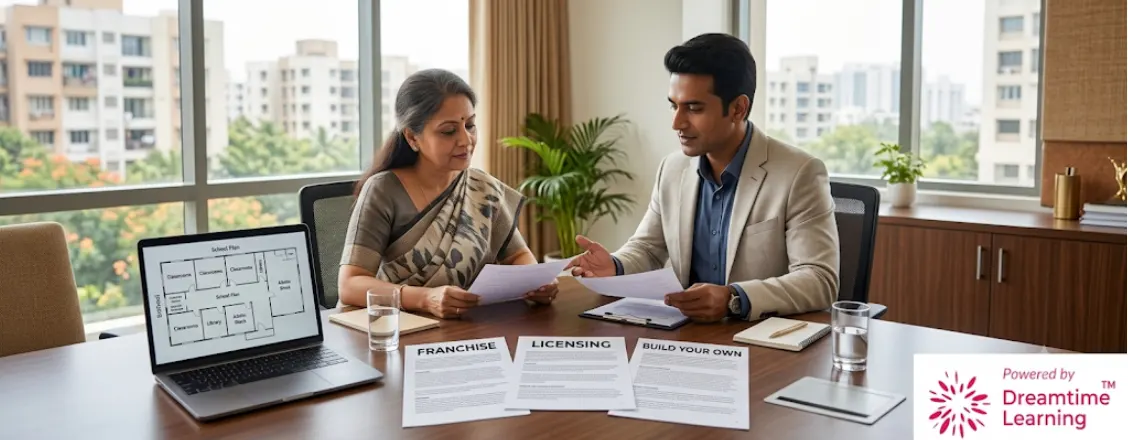
Three routes cover most cases. A conventional franchise gives you a ready brand and a defined system. A licensing partnership gives you the curriculum, training and systems under your own name. Building independently gives you full control, but also the full cost of research, training and technology.
Conventional franchise | Licensing partnership | Build your own | |
Brand | Usually the franchisor’s | Your own | Your own |
Ongoing payments | Often a fee plus royalty (check your agreement) | Services-based fee | Your own R&D and hiring costs |
Curriculum control | Set by the franchisor | Adapted with partner support | Full |
Best for | Owners wanting a ready brand | Owners wanting support and independence | Groups with large academic teams |
With Powered by Dreamtime Learning, you pay a licensing fee based on the services you choose. There are no royalties or percentage cuts, and the school keeps its own name. Our blog on school licensing vs franchising explains the difference in detail.

How can you assess demand in your target location?
National numbers hide local reality, so use them only as context. UDISE+ 2025-26, released on 7 July 2026, reports about 24.72 crore students, a small rise after several years of decline. In an analysis of that data, pre-primary enrolment is reported up 34% to 1.49 crore. Primary enrolment has fallen from 12.18 crore in 2017-18 to 10.19 crore in 2025-26.
That mix means demand varies sharply by area. Map the children aged 2 to 11 in your catchment, list nearby schools with their fees, and visit at pick-up time. Check your state’s Class 1 entry age too. The Union Education Ministry has asked states to set six years, and Delhi applies it from 2026-27. That changes your pre-primary and Class 1 cohorts. Our NEP 2020 guide for school owners explains the structure.
What academic and operational support should you look for?
List what you cannot build alone, then ask who delivers it and how often. Look for curriculum aligned with NEP 2020 and your board, teacher orientation and ongoing training, technology for learning and administration, and operational and marketing guidance. Ask for the support schedule in writing.
Powered by Dreamtime Learning licenses curriculum, teacher training, technology and operations to school owners. See the primary school curriculum, the AI-powered DTL AIQ programme and the student management system for specifics. Our How It Works page lays out the process step by step.
How do ownership, flexibility and ongoing costs affect your decision?
Ownership starts with governance. CBSE’s norms expect the society, trust or company to control the school management committee and any major capital spending. Check that no agreement clause shifts those decisions to an outside party.
Next, test flexibility. Can you adapt the curriculum, change books, add grades or alter your fee structure? Then test the exit: what happens to branding, content and data if you leave, how long is the term, and how does renewal work? Finally, ask for a five-year cost summary that includes setup, licensing, training, technology and any royalty. Compare models on that total, not on the first-year figure.
Can an existing school benefit from an education partnership?
Yes. Many owners expand an existing school by upgrading the curriculum, training teachers and adding grades without changing the school’s name. Powered by Dreamtime Learning’s Transform Your K12 School route covers curriculum, pedagogy and systems upgrades for independent schools. Read how Delhi Public School Chattarpur approached this in its case study. New founders can start with the Start a School process instead. Either way, the same five-part test applies.
What should you ask a potential education partner before deciding?
Bring these questions to every conversation:
Can I see the full agreement, including every recurring payment?
Who owns the brand, curriculum content and student data?
What happens if I decide to leave?
Can I speak to owners of similar schools in similar cities?
What training do teachers receive in year one and after?
How is academic quality reviewed over time?
What does compliance support cover for my board?
If you would like to walk through these answers for your own school, book a call with the team.